A 40 percent chance of showers, mainly after 3am. Increasing clouds, with a low around 60. North wind around 6 mph becoming east southeast after midnight.
Thursday
A 30 percent chance of showers, mainly before 7am. Mostly cloudy, then gradually becoming sunny, with a high near 76. Breezy, with a northwest wind 9 to 14 mph increasing to 17 to 22 mph in the morning. Winds could gust as high as 33 mph. New precipitation amounts of less than a tenth of an inch possible.
Thursday Night
Clear, with a low around 53. Breezy, with a northwest wind 15 to 20 mph decreasing to 6 to 11 mph after midnight. Winds could gust as high as 30 mph.
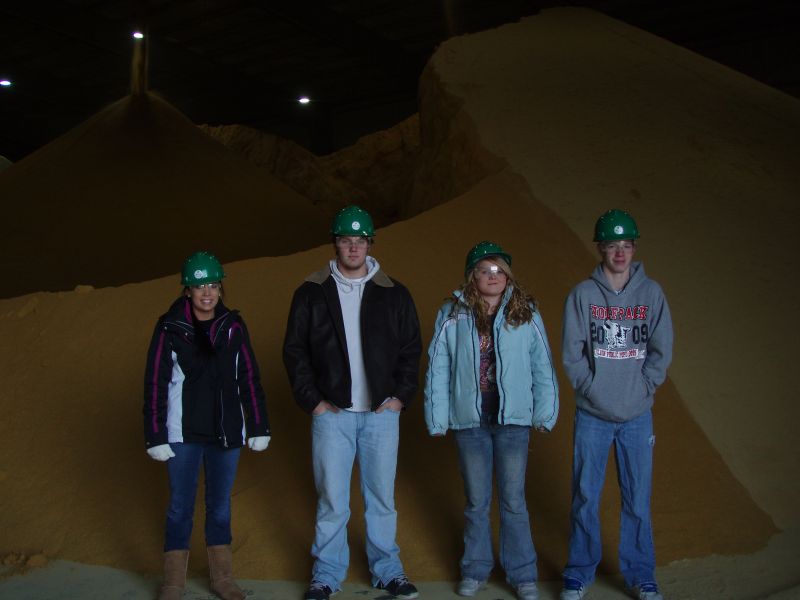
The non-sugar part of the corn will be turned into high protein cattle and chicken food.
Getting a preview of the overall workings before heading outside.
One of the massive fermentation tanks.
Many pipes connect the various machines and holding tanks at the plant.
Most the water is reused, but for the little bit that is emitted, it travels up a long stack where all the particulates will be destroyed before leaving into the air.
Scooping the remains after fermentation.
Each step of the process is checked by chemists for moisture, purity, etc.
Inside the chemistry lab.
Rail cars take the ethanol from the plant to be distributed.
The non-sugar part of the corn will be turned into high protein cattle and chicken food.
On December
3rd, the first really cold day of the year, the Environmental
Science class took a field trip to learn more about renewable
resources and how our choices affect the earth. The students
visited four locations: Siouxland Ethanol, L.L.C. and L.P. Gill
Landfill (both in Jackson), Gavin’s Point Power Plant in Yankton,
S.D., and lastly the Elkhorn Ridge wind farm in
Bloomfield.
Each stop held a wealth of information as students saw first-hand
what goes on at various power-generation facilities. The first stop
was the ethanol plant, where they take local corn and, through a
fermentation process, generate ethanol to be used as a
cleaner-burning gasoline additive. They take in 55,000 bushels of
corn per day! It was interesting to see how high-tech everything is
and how it is monitored on numerous computer displays. They also
told us that about 20% of the fuel they burn is methane gas which
has been piped over from the landfill.
From here we took the short drive to the landfill. The landfill
began in 1981 and has been expanding ever since to meet the needs
of the area. In fact, much of the part one drives on to get to the
dumping area is actually “old landfill” area—hundreds of feet of
trash that have been covered by dirt and now hold grass, trees, and
buildings. There is a 40 foot fence at one edge of the landfill to
prevent debris from flying away, however there is still a lot of
trash that escapes (mostly plastic sacks). They estimate that 40%
of the landfill trash could have been recycled. We also saw the
methane wells in the older landfill areas and the methane shed
where it is collected then piped to the ethanol plant.
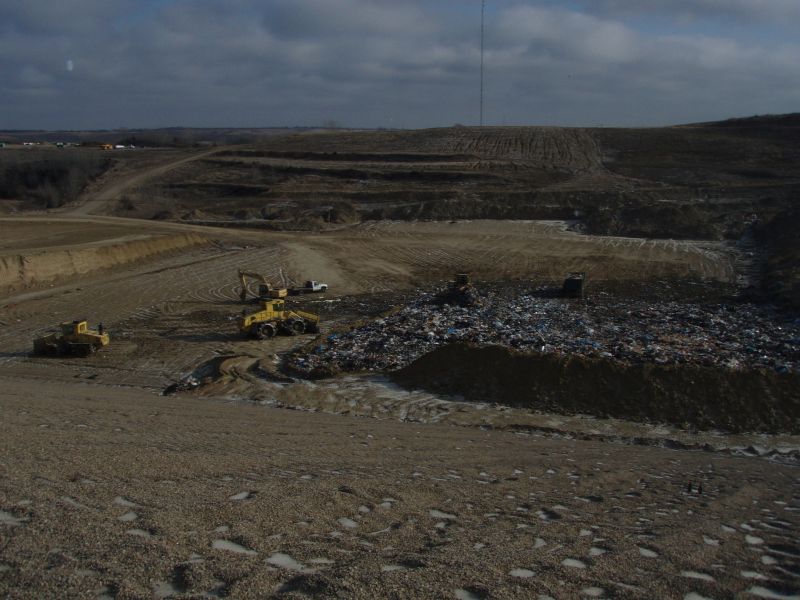
Current area being filled, large machines crush the garbage then cover it with dirt. The tree-filled area in the background will be the next expansion location.
The hill on the right is actually just a giant mound of trash in an area that has already been filled.
Trucks constantly pull in to the landfill, bringing in trash from miles around.
Area of the landfill that is currently being used. It is continually crushed and covered with dirt.
Students got a close-up look at the vast mountains of trash.
A 40' fence helps to keep fly-away debris under control.
Plastic sacks caught in trees.
The most recent area of the landfill to fill up.
Machinery is clearing a new area of waste dumping.
Methane well.
Area currently being filled.
Before the students visited the building with the methane collection equipment in it, they viewed a schematic of its workings.
Ryan feels the temperature of the methane gas pipes.
Current area being filled, large machines crush the garbage then cover it with dirt. The tree-filled area in the background will be the next expansion location.
The next stop—Yankton,
S.D. to visit the Gavin’s Point Power Plant. Students were taken on
a tour of the inside of the power plant where it was nice and warm
for the first time all day! They were shown the generators, the
control room, the turbines, and the other functioning units of the
plant. It was stated that the plant generates enough electricity to
power around 15,000-20,000 homes. Though the smallest of the power
plants on the Missouri River, it serves as the “control station;”
if one of the other power plants lost functioning ability, it could
be controlled from Yankton’s.
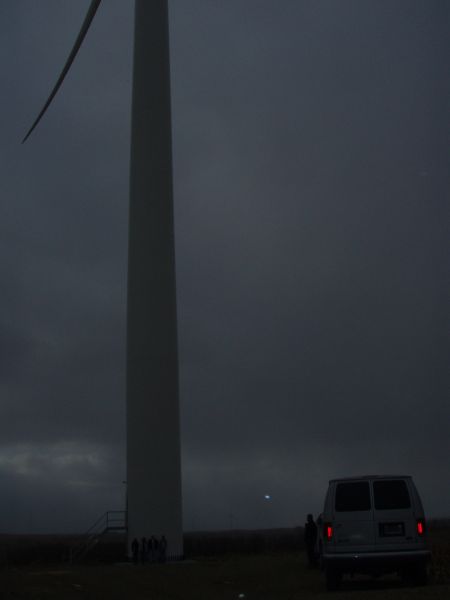
Look closely--the class is standing at the base of the turbine!
Arielle, Morgan, Tyler, Ryan, Mrs. Walsh--in the frigid cold!
In all, there are 27 wind turbines at Elkhorn Ridge.
At Gavin's Point Power Plant (Ryan, Tyler, Arielle, Morgan)
Look closely--the class is standing at the base of the turbine!
Finally we travelled to
Bloomfield to see the wind farm. We were first shown a PowerPoint
about the construction of the wind towers as well as facts about
each. The wind turbines are also monitored on computers; they give
constant readouts of turbine speed and electrical output, among
other readings. Next we braved the cold and visited one of the wind
turbines. Each one is 262 feet tall with each blade being 148 feet
long. Each section of the tower (there are 5) and blades are
preassembled before transportation to the field. Then workers just
“snap” the pieces together on-site. Up close the units are much
different than far away. Some facts the students did not realize:
#1 they are really tall, #2 the outside of a blade may be rotating
at over 300 mph, and #3 the blades actually flux on a windy day
(since they are made of fiberglass).
Check out all the pictures from our trip on the
slideshows!
Environmental Science field trip gives a behind-the-scenes look
No comments have been added yet. Please add yours!